Custom Tang Soo Do Japanese Calligraphy Wall Scroll
You can choose from many options to create artwork with Tang Soo Do characters on a wall scroll...
1. Tang Soo Do / Tang Hand Way
6. Honesty
8. Patience / Perseverance / To Endure / Tolerant
10. San Soo Kung Fu
12. Tang Hand
Tang Soo Do / Tang Hand Way
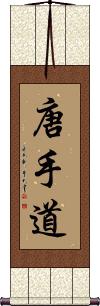
唐手道 is the alternate title for Karate-do.
This title uses a character, 唐, which represents the Tang Dynasty of China. Thus, this is often translated as the “Tang Hand Way” or incorrectly, “Tang Fist Way.”
I have also seen some call it “China Hand Way.”
Many in Korea refer to and romanize these characters as “Tang Soo Do” (당수도) where these characters refer to a kind of Korean style of Karate.
There is not a lot of information on this title but some believe that a simplified form of Kung Fu that started in China and ended up very popular in Japan used this title initially. It was later changed in Japan to a different Karate title which means “Empty Hand” (as in, without weapons).
Note: When used in Korean, this is pronounced 당수도. This title is often romanized as “Tang Soo Do,” “Tangsudo,” “Dang Su Do,” or “Dangsudo.” The last two romanizations on that list are the official Korean government romanization, though martial arts schools tend to use other non-standard versions.
Five Codes of Tang Soo Do
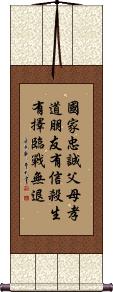
国家忠诚父母孝道朋友有信杀生有择临战无退 are the five codes of Tang Soo Do.
I suggest you have this arranged in five columns when you get to the options page for your custom calligraphy wall scroll.
Here are my translations of each of the five codes:
國家忠誠 Be loyal to your country.
父母孝道 In regards to parents, behave in a filial way.
朋友有信 Be faithful in friendship.
殺生有擇 When fighting for life and death, make noble choices.
臨戰無退 No retreat in battle.
Note: “Tang Soo Do” is a romanization of 唐手道. It's 당수도 in Korean Hangul. It can also be romanized as “Tangsudo” or “Dangsudo.”
Tang Soo Do Tenets
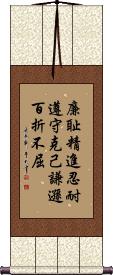
廉耻精進忍耐遵守克己謙遜百折不屈 are the tenets of Tang Soo Do.
| English | Old Hanja | Modern Hangul | Pronunciation |
| 1. Integrity | 廉耻 | 렴치 or 염치 | yeom ci |
| 2. Concentration | 精進 | 정진 | jeong jin |
| 3. Perseverance | 忍耐 | 인내 | in nae |
| 4. Respect & Obedience | 遵守 | 준수 | jun su |
| 5. Self-Control | 克己 | 극기 | geug gi |
| 6. Humility | 謙遜 | 겸손 | gyeom son |
| 7. Indomitable Spirit | 百折不屈 | 백절불굴 | baeg jeor bur gur |
After some research, it appears this list was compiled in English based on Taekwondo tenets. We filled in a few of the words that did not have a corresponding Hanja or Hangul. If someone else has a better list with characters included, please contact me.
Concentration
Chung shin tong il
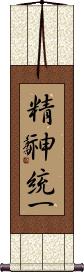
精神統一 means concentration of mind or mental concentration in old Korean Hanja and Japanese.
This concentration title is one of the 8 Key Concepts of Tang Soo Do.
You'll often see this romanized from Korean as “Chung Shin Tong Il.”
If you want to order the modern Korean Hangul version, click on the Hangul characters in the pronunciation box. Otherwise, this title is valid Korean Hanja (from the 1600 years that Korea used Chinese characters).
Bravery / Courage
Courageous Energy
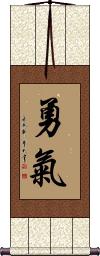
勇氣 is one of several ways to express bravery and courage in Chinese, Japanese, and Korean.
This version is the most spiritual. This is the essence of bravery from deep within your being. This is the mental state of being brave versus actual brave behavior. You'd more likely use this to say, “He is very courageous,” rather than “He fought courageously in the battle.”
The first character also means bravery or courage when it's seen alone. With the second character added, an element of energy or spirit is added. The second character is the same “chi” or “qi” energy that Kung Fu masters focus on when they strike. For this reason, you could say this means “spirit of courage” or “brave spirit.”
This is certainly a stronger word than just the first character alone.
Beyond bravery or courage, dictionaries also translate this word as valor/valour, nerve, audacity, daring, pluck, plucky, gallantry, guts, gutsy, and boldness.
This is also one of the 8 key concepts of tang soo do.
 While the version shown to the left is commonly used in Chinese and Korean Hanja (and ancient Japanese Kanji), please note that the second character is written with slightly fewer strokes in modern Japanese. If you want the modern Japanese version, please click on the character to the right. Both styles would be understood by native Chinese, Japanese, and many (but not all) Korean people. You should make your selection based on the intended audience for your calligraphy artwork. Or pick the single-character form of bravery/courage which is universal.
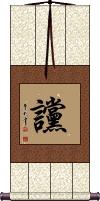
Honesty
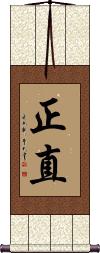
正直 or honesty is being truthful and sincere. It is important because it builds trust. When people are honest, they can be relied on not to lie, cheat or steal. Being honest means that you accept yourself as you are. When you are open and trustworthy, others can believe in you.
正直 is one of the 8 key concepts of Tang Soo Do.
Note: This entry is cross-listed as "integrity" because it also fits that definition.
 Please note that the second Kanji sometimes has an alternate form in Japanese. Let us know if you want the alternate form shown to the right.
Kung Fu San Soo / San Shou
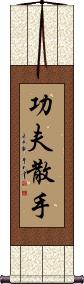
功夫散手 is a martial arts title.
Oddly, there are multiple ways two spell/romanize this in English, but in Chinese, it's written exactly the same.
Technically, the Mandarin romanizes as “gong fu san shou,” for which you'll sometimes see it written “kung fu san shou” (k'ung is an old romanization for a word that sounds like gong with a vowel sound like “oh”).
There is another martial arts style that spells this “Kung Fu San Soo.” I guess this was supposed to approximate Cantonese pronunciation for which the scholarly romanization is generally agreed to be “gung fu saan sau.”
Patience / Perseverance / To Endure / Tolerant
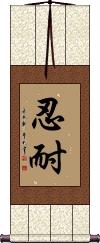
忍耐 is patience, the quiet hope, and trust that things will turn out right.
You wait without complaining. You are tolerant and accepting of difficulties and mistakes. You picture the end in the beginning and persevere to meet your goals.
忍耐 can also mean “to endure,” “restrain oneself,” or “forbearance,” and in some contexts, it can mean “perseverance” or “endurance.”
忍耐 is also used as a tenet of Taekwondo, Tang Soo Do, and other Korean martial arts where it's titled “Endurance” and romanized as “In Neh.”
 Note that when writing this as Kanji, Japanese will tend to write the first character in the form shown to the right. If you select our Japanese master calligrapher, please expect this Kanji form (yes,
it’s
just one stroke that is slightly different in location, crossing another stroke in the Japanese Kanji form).
Note that when writing this as Kanji, Japanese will tend to write the first character in the form shown to the right. If you select our Japanese master calligrapher, please expect this Kanji form (yes,
it’s
just one stroke that is slightly different in location, crossing another stroke in the Japanese Kanji form).
See Also: Peace | Harmony | Perseverance
San Soo / San Shou
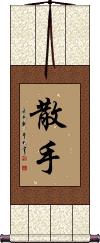
散手 is a martial arts title sometimes spelled in English as “San Soo” or “San Shou.”
The Mandarin version romanizes as “San Shou.” Mandarin Chinese is the most common dialect in China (literally 99% of Chinese people speak standard Mandarin along with their local dialect).
There is another martial arts style that spells this “San Soo.” I guess this was supposed to approximate Cantonese pronunciation for which the scholarly romanization is generally agreed to be “Saan Sau.”
San Soo Kung Fu
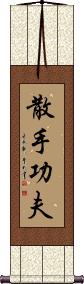
散手功夫 is San Soo Kung Fu.
Sometimes you will see this in the order 功夫散手 (Kung Fu San Soo). Either version is OK.
It's like “Kung Fu of San Soo” vs. “San Soo Kung Fu” if you put it in English terms. San Soo is the adjective either way in Chinese.
Honest / Straightforward
Tang Hand
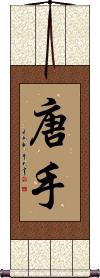
唐手 is a very seldom-used title for Karate.
This title uses a character that represents the Tang Dynasty of China. Thus, this is often translated as the “Tang Hand” or, incorrectly, “Tang Fist.”
I have also seen some call it “China Hand.”
There is not a lot of information on this title but some believe that a simplified form of Kung Fu that started in China, and ended up very popular in Japan used this title initially. It was later changed in Japan to a different Karate title which means "Empty Hand" (as in, without weapons).
I am sure that some will suggest a different history or argue a different origin. I think that nobody can be sure.
Note: Just like the more conventional Karate title, this one can have the "way" or "method" character added to the end, as in Karate-Do.