Custom In Wine There Is Truth Chinese & Japanese Calligraphy Wall Scroll
We have many options to create artwork with In Wine There Is Truth characters on a wall scroll or portrait....
Frightful Demon / Asura
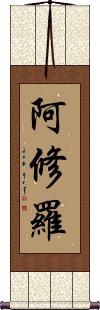
This demon title comes from the ancient Sanskrit word Asura.
阿修羅 is often used in Buddhism when describing various demons. Sometimes defined as “Fighting and battling a giant demon.”
In the context of Buddhism: This title originally meant a spirit, spirits, or even the gods (perhaps before 1700 years ago). It now generally indicates titanic demons, enemies of the gods, with whom, especially Indra, they wage constant war. They are defined as “not devas,” “ugly,” and “without wine.” There are four classes of asuras, separated according to their manner of rebirth. They can be egg-born, womb-born, transformation-born, and spawn- or water-born. Their abode is in the ocean, north of Sumeru but certain of the weaker dwell in a western mountain cave. They have realms, rulers, and palaces, as have the devas.
In terms of power, Asuras rank above humans but below most other deities. They live near the coastal foot of Mount Sumeru (on the northern side). Their domain is partially or wholly in the ocean.
Wine
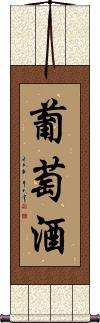
葡萄酒 is the Chinese, Japanese Kanji, and old Korean Hanja for wine.
Very specifically, this is for grape wine (an important distinction in Asia where most wines were rice-based until western influences came into play).
The first word, 葡萄 literally means grape (or grapevine), and 酒 means alcohol (generic term for alcohol, sake, wine, liquor).
Hua Tuo
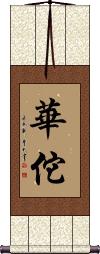
華佗 or Hua Tuo was a Chinese physician who lived during the late Eastern Han dynasty.
The historical texts Records of the Three Kingdoms and Book of the Later Han record Hua Tuo as the first person in China to use anesthesia during surgery.
Hua Tuo used a general anesthetic combining wine with a herbal concoction called 麻沸散, literally, “cannabis boil powder.” This was in the second century AD, almost 1700 years before western medicine had any form of anesthesia (1846).
Sherry
(strong wine)
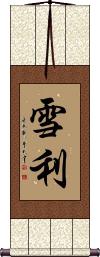
Just for fun, if you want to name yourself after the alcoholic drink, you can use this name.
雪利 is what they call sherry (extra strong wine) in China.
Sumptuous Debauchery
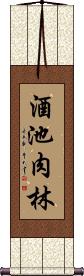
酒池肉林 is a Chinese idiom that is also somewhat known in Japanese and Korean.
This literally means “lakes of wine and forests of meat.”
Figuratively, it refers to debauchery, sumptuous entertainment, a sumptuous feast, or any kind of ridiculously-lavish spread of food and wine.
In Wine there is Truth
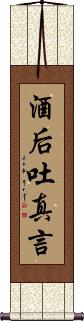
酒后吐真言 / 酒後吐真言 is a nice Asian proverb if you know a vintner or wine seller - or wine lover - although the actual meaning might not be exactly what you think or hope.
The literal meaning is that someone drinking wine is more likely to let the truth slip out. It can also be translated as “People speak their true feelings after drinking alcohol.”
It's long believed in many parts of Asia that one can not consciously hold up a facade of lies when getting drunk, and therefore the truth will come out with a few drinks.
I've had the experience where a Korean man would not trust me until I got drunk with him (I was trying to gain access to the black market in North Korea which is tough to do as an untrusted outsider) - so I think this idea is still well-practiced in many Asian countries.
 VS
VS 
Please note that there are two common ways to write the second character of this phrase. The way it's written will be left up to the mood of the calligrapher, unless you let us know that you have a certain preference.
See Also: Honesty
Wine / Alcohol / Sake
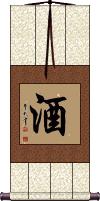
酒 is the Chinese character, Korean Hanja, and Japanese Kanji which means alcohol.
This can refer to wine (esp. rice wine), liquor, spirits, sake, or to alcoholic beverages in general.
In the west, we tend to say “sake” to mean Japanese rice wine, however, this character is a little ambiguous in Japanese. It literally just means alcohol and is often pronounced “shu” in Japanese. Specifically, in Japanese, you might want to ask for “seishu” or 清酒 to get the sake that you are used to in the west. Seishu literally means “clear alcohol.”
Zhang Fei
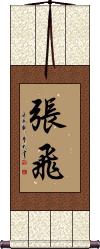
張飛 is the name of General Zhang Fei, of the Shu Kingdom. He was blood-brother of Liu Bei in the semi-historical novel “Romance of the Three Kingdoms.” Zhang Fei is famous for his heroic and fearsome fighting and his love of wine.
In Japanese, this can be the name Chouhi.
This in-stock artwork might be what you are looking for, and ships right away...


