Buy a wall scroll with Jade in Chinese characters and Japanese Kanji.
1. Jade
2. Time is more valuable than Jade
4. You are who you hang out with
5. Gem
6. Lucky / Auspicious / Good Omen
7. Jade
8. Khánh
9. Kingfisher
10. Sandaiyu
11. Sapphire
Jade
(precious stone)
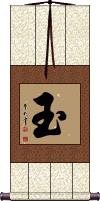
玉 is how to write jade in Chinese, Korean Hanja, and Japanese Kanji. This refers to the semi-precious stone that can be almost white or a vivid green.
Note: In Japanese, this character can mean jewel, ball, sphere or coin depending on context.
If your name is Jade, you may want to choose this to represent your name by meaning rather than pronunciation.
Jade
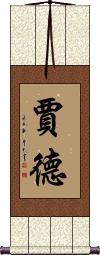
賈德 is the transliteration to Mandarin Chinese for the name Jade.
This is meant to sound like the English pronunciation of jade using Mandarin Chinese sounds. It does not mean jade.
I suggest the character that means jade rather than this if your name is Jade.
Time is more valuable than Jade
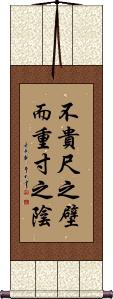
不贵尺之壁而重寸之阴 literally translates as: Treasure not a foot long [piece of] jade, [rather] treasure an inch of time.
Figuratively, this suggests that time is the most important/valuable thing in life.
Death Before Dishonor
Better to be broken jade than unbroken pottery
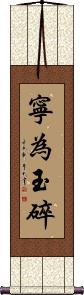
寧為玉碎 is the short version of a longer Chinese proverb which means “rather be shattered piece of jade than an unbroken piece of pottery.”
寧為玉碎 says the “rather be a broken piece of jade” part (the second half is implied - everyone in China knows this idiom).
A little more explanation:
Death is implied with the “broken” meaning. Jade is one of the most precious materials in Chinese history, and in this case, is compared with one's honor and self-worth. Pottery is just something you eat off of; it has no deep value, just as a person who has lost their honor or had none to begin with.
Thus, this means “better to die with honor than to live in shame” or words to that effect.
This is often translated in English as “Death Before Dishonor,” the famous military slogan.
I would also compare this to the English proverb, “Better to die on your feet than to live on your knees.”
Death Before Dishonor
Better to be broken jade than unbroken pottery
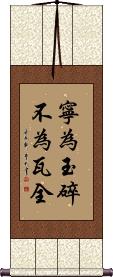
寧為玉碎不為瓦全 is the long version of a Chinese proverb that means “rather be shattered piece of jade than an unbroken piece of pottery.”
A little more explanation:
Death is implied with the “broken” meaning. Jade is one of the most precious materials in Chinese history, and in this case, is compared with one's honor and self-worth. Pottery is just something you eat off of, it has no deep value, just as a person who has lost their honor, or had none to begin with.
Thus, this means “better to die with honor than to live in shame” or words to that effect.
寧為玉碎不為瓦全 is often translated in English as “Death Before Dishonor,” the famous military slogan.
I would also compare this to the English proverb, “Better to die on your feet than to live on your knees.”
You are who you hang out with
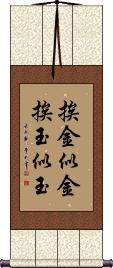
金似金挨玉似玉 is a Chinese proverb that literally translates as: [One who is] close to gold [is] like gold [and one who is] close to jade [is] like jade.
Figuratively, this means:
A good environment produces good people.
People are influenced by the company they keep.
Basically, if you hang out with good people, you are likely to become or stay good yourself. The opposite also is true. 挨This is like the moral version of “You are what you eat.”
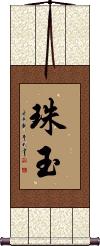
珠玉 is a Chinese, Japanese Kanji, and old Korean Hanja word meaning gem.
Beyond just the word gem, this can refer to pearls and jades, jewels, clever remarks, beautiful writing, gems of wisdom, genius, or an outstanding person.
If your name is Gem, this is a nice way to represent your name in 3 Asian languages. Though the pronunciation will be far from Gem, the meaning of gem is really nice.
Note: In Japanese, this is sometimes used as the female given name, Tama.
Lucky / Auspicious / Good Omen
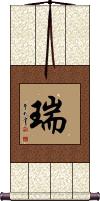
瑞 is a Chinese, Japanese, and old Korean word that means: lucky; auspicious; propitious; freshness; purity; luster; a good omen.
In Japanese, this can be the following female given names: Yutaka; Midzuho; Mizuho; Mizuki; Mizue; Mizu; Mio; Tamami. It can also be a Japanese surname, Zui or Shirushi.
In the Buddhist context, this can represent an auspicious jade token or good omen.
Jade
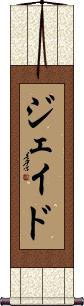
ジェイド is the name Jade in Japanese.
This is meant to sound like the English pronunciation of jade. It does not mean jade.
Note: Because this title is entirely Japanese Katakana, it should be written by a Japanese calligrapher.
Khánh
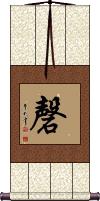
磬 means “chime stones,” but I'm including it here for those looking for the original Chinese character for the Vietnamese name Khánh.
Other definitions include ancient percussion instrument made of stone or jade pieces hung in a row and struck as a xylophone, sounding stone, ancient Chinese chime shaped like a chevron.
There is also a possibility that your original character is 慶 which means to celebrate or felicity. Contact me if you need that character.
Kingfisher
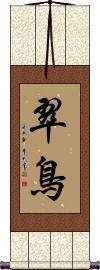
翠鳥 is the title for the kingfisher bird in Chinese.
翠 means bluish-green or green jade.
鳥 means bird.
Sandaiyu
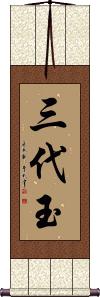
三代玉 is the name Sandaiyu in Chinese (Mandarin).
This is also the title for “three-generation jade.”
Sapphire
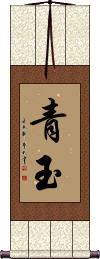
青玉 is a Japanese word that means sapphire or jacinth.
青玉 literally means blue/green jade.
This in-stock artwork might be what you are looking for, and ships right away...