Commitment Chinese / Japanese Calligraphy Wall Scroll
You can choose from many options to create artwork with Commitment characters on a wall scroll or portrait.
Start your project by clicking on the "Customize & Buy" button next to your favorite commitment-related title below...
1. Passionate Love / Ardent Love and Devotion
2. Commitment
3. Dedication
4. Devotion / Dedication / Attentive / Focused
5. Devotion to your Profession / Career
6. Diligence
7. Enthusiasm
10. One Heart / One Mind / Heart and Soul
13. Enthusiasm / Passion for a Cause
14. Sacrifice / Devotion / Dedication
16. Together Forever
Passionate Love / Ardent Love and Devotion
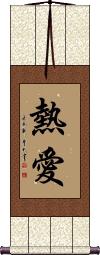
熱愛 means love passionately, ardent love, devotion, adoration.
The literal meaning is “hot love,” as the first character means heat, fervent, hot, and warm. Sometimes it can mean fever, restlessness, or zeal. The second character is, of course, love. If you adore and are devoted to someone with all your love, this is the title for you.
Commitment
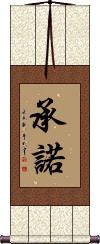
承諾 embodies the idea of commitment but also means to make a big effort or to undertake a great task.
Commitment is caring deeply about something or someone. It is deciding carefully what you want to do and then giving it 100%, holding nothing back. You give your all to a friendship, a task, or something you believe in. You finish what you start. You keep your promises.
In Chinese, this word directly means to undertake something or to make a promise to do something.
Outside of the commitment idea, this particular word can also mean approval, acceptance, consent, assent, acquiescence, or agreement, depending on context (especially in Japanese and Korean). Therefore, this word is probably best if your audience is Chinese.
See Also: Partnership | Hard Work | Dedication
Dedication
Dedicated to One Thing
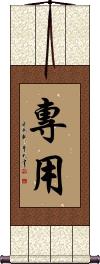
專用 is the dedication you might have to your job or a person.
Trivia: It is the same word used as an adjective in front of the word for “network” to say “dedicated network” in Chinese.
Please note: While this is a word in Korean, the meaning is private or “exclusive use.” So this is best if your audience is Chinese.
Dedication
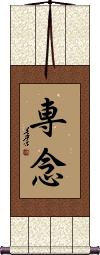
専念 is the Japanese word for dedication.
It means “give undivided attention” or “devote oneself to (something).”
Note: This can be pronounced in Korean, but it's not a commonly used term.
Devotion / Dedication / Attentive / Focused
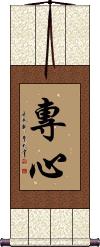
專心 makes a word that means “paying attention with your heart.”
It's often translated as “dedication,” as in “be absorbed in” or “concentrate one's efforts.” It's also used to mean “with the single mind,” “whole-heartedly,” “paying attention,” “undivided attention,” “concentration (-ed),” “engrossed,” “devotionally (listening/watching),” and/or “attentive.”
The first character means “for a particular person, occasion, or purpose,” “focused on one single thing,” “concentrated,” and sometimes, “special.”
The second character means “heart” or “mind” by itself.
My favorite translation, which comes from the Oxford Advanced Chinese/English Dictionary, is, “wholehearted devotion.”
If it seems like the meaning of this word is quite open, you are correct. The context in which the word is used matters a lot. It can mean different things depending on how you use it. This makes it kind of nice as you can decide what this means to you (within some limits). This is always positive in meaning, so even if a Chinese person reads it differently than you, it will still have a good meaning.
 In Japanese, they tend to use a variation of the second character which has one less stroke. If you want your calligraphy written this Japanese form, please click on the Kanji shown to the right instead of the button above. Note: Japanese and Chinese people will recognize either form.
Devotion to your Profession / Career
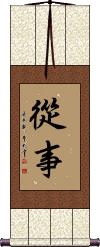
從事/従事 is often used to describe the devotion someone has to their profession - However, it can just mean career, depending on context.
We don't highly recommend this selection for a wall scroll.
In more simple terms, this word also means undertake / to deal with / to handle / to do. It does not have to refer to a career issue, as it could be used to encourage someone that is beginning their university studies etc.
This kind of makes sense in Japanese, however, there is a slight deviation in the way they write the first Kanji in Japanese.
 Please note that Japanese use an alternate version of the first character. Click on the character to the right if you want the Japanese version of this two-character Devotion-to-your-Profession calligraphy.
Diligence
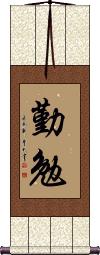
勤勉 can be translated as diligence, industrious, assiduity, assiduous, diligent, or sedulity.
Diligence is working hard and doing your absolute best. You take special care by doing things step by step. Diligence helps you to get things done with excellence and enthusiasm. Diligence leads to success.
See Also: Hard Work | Tenacity | Passion for a Cause
Enthusiasm
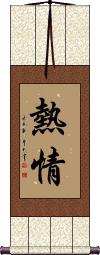
熱情 is a Chinese and Korean word for enthusiasm that can also be translated as passion (for a cause), ardency, ardor/ardour, enthusiasm, or zeal.
Enthusiasm is being warm, cheerful, happy, and full of spirit. It is doing something wholeheartedly and eagerly. When you are enthusiastic, you have a positive attitude.
In some contexts, this could mean being extremely fond of something or having a fondness for a cause or person.
This Chinese word can also be translated as "sincere and warm" or literally "warm sentiment / affection."
See Also: Motivation | Passion | Tenacity
Honor Courage Commitment
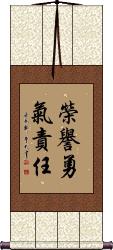
榮譽勇氣責任 is a word list that reads, “榮譽 勇氣 責任” or “honor courage commitment.”
If you are looking for this, it is likely that you are in the military (probably Navy or Marines).
We worked on this for a long time to find the right combination of words in Chinese. However, it should still be noted that word lists are not very natural in Chinese. Most of the time, there would be a subject, verb, and object for a phrase with this many words.
Honor Courage Commitment
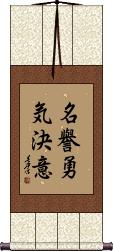
This means “Honor, Courage, Commitment” in Japanese.
名譽勇気決意 is a common military phrase in English used in the Navy and Marines.
This is a word list, which is not the most natural kind of composition in Japanese (usually there is a subject, object, and verb - or a single word).
Resolute Mind
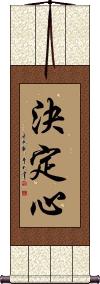
決定心 means the mind of certainty, resolute mind, imperturbable mind, firm determination, firm resolution, or stable commitment.
In the context of Buddhism, this is the deep resolution needed to attain enlightenment.
If you go to a deeper meaning, this is a condition of settling into the thought that occurs in the process of perception subsequent to the “seeking mind” or “尋求心.”
One Heart / One Mind / Heart and Soul
Isshin
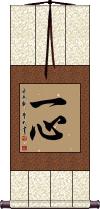
一心 can be translated as “one mind,” “single-minded focus,” or “wholehearted devotion,” from Chinese, Japanese Kanji, and old Korean Hanja.
Colloquially or figuratively, it means: wholeheartedly; heart and soul; of one mind; single-mindedness, wholeheartedness; one's whole heart; with the whole mind or heart; one mind in heart.
I'm not kidding, all of those came right from the dictionary for this one title.
In martial arts usage, this term emphasizes total commitment, where intent, attention, and action are unified without distraction.
In Japanese budō, it often conveys wholehearted dedication to practice or principle, whereas in Chinese usage it tends toward inner mental cultivation.
In Buddhism, this can refer to the bhūtatathatā, or the whole of things; the universe as one mind, or a spiritual unity.
In Japanese, this can be the female given name, Hitomi.
Partnership: Marriage
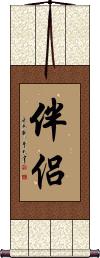
伴侶 is a Chinese, Japanese, and old Korean word that expresses the kind of partnership in which a good marriage is founded.
伴侶 could also be translated as mates or companionship or as a noun to refer to a partner or companion.
This does not have to include marriage but at least refers to a partnership with a deep relationship or bond.
Note that this is not the same as a business partner. Different words are used for various types business partnerships.
See Also: Friendship
Passion for a Cause
Depending on the context, 熱情 can mean “cordial,” “enthusiastic,” “passionate,” or “passionately.”
This version is sometimes used in Japanese, but the character order is more common in Chinese and Korean Hanja. The meaning in Japanese for this Kanji order is ardor/ardour or zeal but rarely used in modern Japan. I suggest you choose a different version of “passion” if your audience is Japanese.
See Also: Persistence | Devotion | Tenacity | Motivation
Enthusiasm / Passion for a Cause
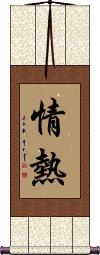
情熱 is the Japanese word that means enthusiasm or “passion for a cause.”
In some contexts, this could mean being extremely fond of something or having a fondness for a cause or person.
Can also be translated as passion, zeal, ardor/ardour, or fervor.
Note: This word (or character order) is not natural in Chinese. However, a typical Chinese person can guess this is a Japanese or Korean word and understand the intended meaning. This selection is best if your audience is Japanese or old-school Korean.
See Also: Persistence | Devotion | Tenacity | Motivation
Sacrifice / Devotion / Dedication
(complete bodily devotion)
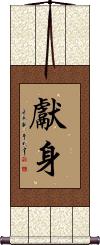
獻身 is used to describe being so devoted to something that you will make sacrifices for that goal/thing/person.
You can also translate this word as any of the following:
Sacrifice one's life for...
To dedicate oneself to...
Self-devotion
Dedication
Devote to...
Self-sacrifice
Giving your whole body to...
This can be a dedication to or for someone but is often used as a dedication or making sacrifices for your country, public service, or a cause. For instance, an Olympic athlete makes great sacrifices to train in his/her sport for their country and compatriots.

 While the form shown to the upper-left is considered an ancient Japanese version, in modern Japan, they use the simplified version of the first Kanji (shown to the right). Click on the Kanji at the right instead of the button above if you want this modern Japanese version.
If you are looking for a more religious meaning of devotion, see Faith.
See Also: Confidence | Dedication
Sincerity and Devotion
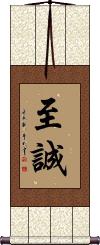
至誠 is the idea that you enter into something with the utmost sincerity and fidelity. Ideas such as devotion, honesty, and “one's true heart” are also contained in this word.
至誠 is a universal word as the Chinese, Japanese Kanji, and Korean Hanja are all identical.
Together Forever
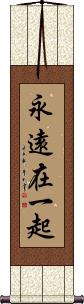
永遠在一起 is “together forever” in Chinese.
This is a great idea for couples making a commitment of a lifetime.