Buy a wall scroll with Angel in Chinese or Japanese.
See also: Spirit or Christian.
Below you will find the titles for Angel (Messenger of Heaven) as well as transliterations for the name Angel into Mandarin Chinese.
Start your project by clicking on the button next to your favorite title below...
1. Angel / Messenger of Heaven
2. Angel
4. Dark Angel
5. Fallen Angel
7. God Bless You / May God Protect You
10. Protection
11. Protector
12. The Saint
13. Holy Man / Saint
Angel / Messenger of Heaven
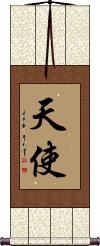
天使 is the meaning of Angel in Chinese, Japanese Kanji, and old Korean Hanja.
The first character means heaven. The second means messenger. Together it makes sense that we are talking about angels as Heaven's Messengers.
If you are an “Angel Junkie,” this may be the wall scroll for you.
I also think it's a great choice if your name happens to be Angel.
Angel
(Name Version 1)
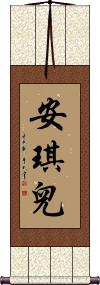
安琪兒 is the most common transliteration to Mandarin Chinese for the name Angel.
It is supposed to sound like Angel but to be honest, this one misses the mark.
I would go with the meaning of Angel if I were you.
Angel
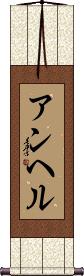
アンヘル is the name Angel in Japanese.
This sounds like “Angel” but does not mean “Angel.”
Note: Because this title is entirely Japanese Katakana, it should be written by a Japanese calligrapher.
Angel
(Name - Version 2)
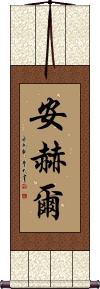
安赫爾 is another common transliteration to Mandarin Chinese for the name Angel.
This one misses the mark too - It uses a hard “H” sound to simulate the “J” sound of the “G” in this name. I don't know who transliterated these first and how it became the standard.
Again, I recommend using the meaning of Angel above.
If anything, this is the more masculine form of Angel. This is also the form commonly used for the masculine Latin name Ángel.
Archangel / Arch Angel
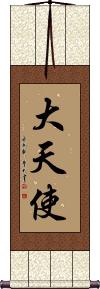
大天使 is the title Archangel in Chinese characters, Japanese Kanji, and old Korean Hanja.
The first character means big or great (in this case, it means “arch”).
The second means heaven (or sky).
The last means messenger.
The second and third characters together make the title for angel, which is literally “Heaven's Messenger.”
This title would be understood as “The Chief of all Angels,” or “The Great Angel.” Some might even say it's the boss of Angels.
Dark Angel
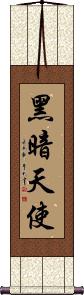
黑暗天使 means “Dark Angel” in Chinese.
The first character means black, but the second means dark by itself, so this can also be written with the first character dropped.
The last two characters mean angel.
Dark Angel
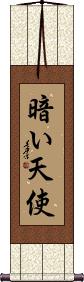
暗い天使 means “Dark Angel,” in Japanese.
The first character means dark, gloomy, hidden, or secret.
The second character is a connecting article.
The last two characters mean angel.
Dark Angel
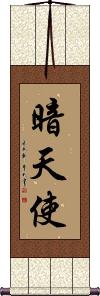
暗天使 is the shortest way to write, “Dark Angel,” in Chinese.
This literally reads, “dark heaven's messenger.”
天使 means “heaven's messenger” but is always understood as “angel.”
Fallen Angel
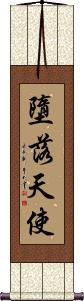
墮落天使 means “fallen angel” in Chinese.
墮落天使 is also the title of a 1995 movie that was popular in Hong Kong.
墮落 means to degrade, degenerate, become depraved, corrupt, fall from grace, or descend.
天使 means angel (more literally “heavenly messenger” or “divine messenger”).
Fallen Angel
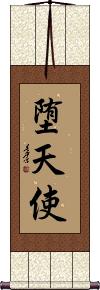
堕天使 is the Japanese title for a fallen angel.
This can also refer to a demon or Satan.
Guardian Angel
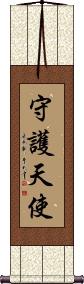
守護天使 is the title used for guardian angel in Chinese and Japanese Kanji.
It's used in the same way we use this title in the west - such as a guardian angel watching out for you and allowing you to survive a disaster or accident.
The first two characters mean to guard and protect. The second two mean “angel” (literally “Heaven's messenger”).
God Bless You / May God Protect You
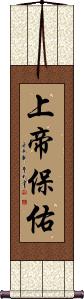
上帝保佑 is a blessing exchanged between Chinese Christians.
The first two characters mean God (The God of Zion). The second two characters express the idea of giving protection. Another way to translate this is “May God protect you.”
See Also: Guardian Angel
Holy Mother / Saint Mary
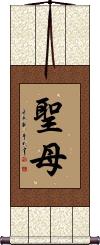
聖母 is the title for the Holy Mother, Madonna, or Virgin Mary used by Catholic Chinese, Korean, and Japanese people.
I think this would be a very cool wall scroll for a devout Catholic who also appreciates Asian artwork and language.
Note: Koreans often put a third character after these two, which creates a title that means “Hail Mary”; however, this character is not added or used in the same way in Japanese or Chinese. If you want that Korean title, just let me know, and we'll add that character for you. The two-character title shown to the left is universal, so I think it's the best choice.
Blessings and Protection
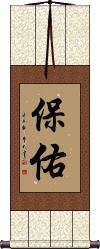
保佑 is the more religious and sometimes superstitious word for protection in Chinese. It's sort of a blessing of protection and is often translated as “bless and protect,” “blessing,” or “to bless.”
This would be used as the protection or blessing that a deity (such as God) would bestow upon you. It is not religion-specific in the same way a language cannot be specific to any religion.
See Also: Guardian Angel
Protection
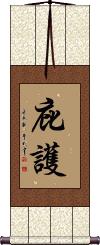
庇護 is not the most common word for a wall scroll, but this is the word for protection in Chinese, Japanese Kanji, and old Korean Hanja.
庇護 is the non-religious, non-superstitious form of protection.
庇護 can be translated as shelter, shield, defend, safeguard, take under one's wing, to put under protection. In a certain context, it means to grant asylum or give refuge and sanctuary.
See Also: Guardian Angel
Protector
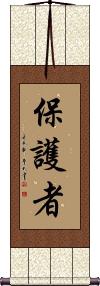
保護者 is the universal word for protector in Chinese, Japanese Kanji, and old Korean Hanja.
The first character means to defend, to protect, to insure or guarantee, to maintain, hold or keep, or to guard.
The second character means to protect.
Together the first and second characters create a word that means to defend, protect, or safeguard.
The last character means person.
Add all three characters together, and you have a word that means “protector,” one who will protect, guard, and keep you safe.
Some will also translate this word as guardian or patron.
See Also: Guardian Angel
The Saint
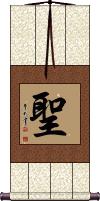
聖 is the simple, single-character religious form of “saint” in Chinese (also holds the same meaning in Japanese and Korean, though rarely used alone like this).
This can also mean holy, sage, master, or priest.
Note: 聖 is often used in compound words (words of more than one character) to create further meanings. In compounds, it can mean holy, sacred, or divine.
聖 is also used as the first word for Spanish and English place names such as “San Diego” and “St. Louis” in Chinese (not Japanese).
In the Buddhist context, this can represent ārya or sādhu. And mean a sage; wise and good; upright, or correct in all his character; sacred, holy, or saintly.
The Saint
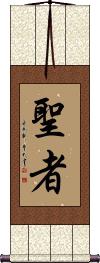
聖者 is the religious way to express the idea of “Saint” in Chinese, Korean Hanja, and Japanese Kanji.
Some may translate this as “Holy man” or “Holy person.”
Holy Man / Saint
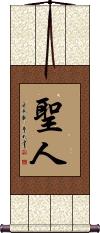
聖人 can mean saint, sage, or holy man.
Note: There is more than one way to express this idea. This one really matches “Holy man” because the second character means “human” or “person” (therefore, this could equally mean “Holy woman”).
This in-stock artwork might be what you are looking for, and ships right away...